Friday, September 26, 2014

Following Comté from Fromagerie No. 25 to Fort St. Antoine


Sebastian Muller
Fromagerie No. 25
Frutière a Comté des Hospitaux Vieux
Place de la Marie

The truck leaves at 3 am to collect milk from ten producers across three villages. Each farmer has about forty Montbeliard cows. This pickup run is called Ramassage. The old method, called La Coulée, where producers delivered their own milk, is practiced by at just a few frutières of the thirty-four in the area. By AOC rules, the milk must be processed within twenty-four hours. May is the big milk month.

Fromagerie No. 25, built in 1920, is run by one man, Sebastian Muller. He makes twelve wheels a day seven days a week, using 1.6 million liters of milk per year. It’s about average for a cheese maker that delivers to Marcel Petite, but small in the scheme of things. A big Comté fruitiere makes 5 times as much. The work for the cheese maker, like that for cheese makers everywhere, is endless. Sebastian can arrange for a few days off only if he reroutes his milk to another fromagerie, or gets another cheese maker to substitute for him. He extended his wet arm for us to shake. He works very fast, with few words to us. He’s probably not used to company.

The milk truck is hooked up outside in the small parking lot on the hill overlooking the valley. It has a long hose and the milk is pumped in. Inside, where things are wet and smell sweetly ammoniated, the milk is heated by a radiator and delivered to one of two big copper vats. Rennet is added, curds form, and Sebastian cuts them with a rectangular wire mesh, kind of like a big hard boiled egg slicer. This releases water. The temperature raises to 55 C, drying and cooking the curd. When the curd passes the test—the cheesemaker puts his hand in and no curd sticks to it—it's ready to pump overhead into the cheese molds. 

Comté cheese press

Until now the curds have been treated gently. The next process is brutal. A big vacuum hose lifts the curds ten feet in the air and shoots them fifteen feet across the arched ceiling, unceremoniously plopping them in one of four mold machines. Pressed for eight hours, held in their mold until the next morning, they’re ulimately brought to “The nursery” where they practice being cheese for three to four weeks, washed daily with morge, a brine made of water and the scraped crust of older cheese. It’s the mother culture of the cheese maker, like a bread starter is to a baker, one of the things that gives a cheese from a single fromagerie its unique flavor. The baby cheeses are—ironically bigger now then they'll be when they "grow up", since they lose water—are stored on spruce shelves, which the skin of comté enjoys as it turns to rind. The shelves are rough cut, harvested when the sap has drained from them. You can see thick, raw grains across the boards. That lets a little bit of air pass under the cheese as it rests; wheels don’t stick.

Marcel Petite’s trucks visit every month to pick up young wheels.

Fort St. Antoine

Marcel Petite
Fort Lucotte de Saint Antoine
                                  
“You feel like you’re coming to the center of the cheese world: of industry, quantity, quality.”
Jason Hinds, Essex St. Comté

The road leads up through the village, past some hills and a small forest. The fort is built underground, alone and invisible, marked only by a ten foot tall door built into a hill. You park and enter by walking across a moat. The smell is warm butter and pine. You’re ushered up to the lunch room first, for espresso, the cheese halls flash by on your left. A few of the staff are reading papers, eating cheese, drinking a 1998 Cotes du Jura, part of which has found its way into a plastic water bottle. Windows open onto the Mont d’Or, leaves umber and rust, but the grass is still very green. It’ll be that way until first snow in December. 

Cheeses arrive from the fruitières regularly, 80% of which are in the mountains, along the Swiss border. The hills were forested ten centuries ago, now cows graze on them. First stop is the top level, La Maternelle, another nursery. Wheels are doused with sea salt to draw out more water, washed with cool water to keep the “wrong” bacteria from being active. Today there are about 25,000 wheels. They’ll stay there for 6 months when they’ll come down and join the 35,000 wheels in the lower rooms. 


Fort St. Antoine's main room, the Church of Cheese
Lights, camera—but nothing prepares you for entering the Church of Cheese. The main room of the fort, once a covered garden, holds 9,000 wheels of comté, each three feet across, seventy pounds, rising twenty feet high under a cathedral ceiling. The wheels look like rounds of wood or stone, in various stages of growth, their surfaces sometimes smooth, other times mottled, molded, warty, covered in patterns that look like lichen, rust, sandstone or bird shit. Absolute silence, once in a while broken by the whir of little electric hand carts. Or the lonely cheese washing robot that haunts the aisles. Little rooms are off to the side. They used to hold 52 soldiers each, now they store 900 wheels of comté.

I'm escorted by the affineur, called the chef de cave Claude, and his other half, Phillipe Goux, head of sales. Claude is dressed in white jacket and white hat, with nothing more than a note pad and cheese iron as tools. Mr Goux, born in Jura, eats comté two or times a day. He prefers younger cheese.

The fort has its own micro climates. There are no heaters or humidifiers, just the bricks and the earth outside them. Grass grows in some areas. Claude taps, touches, tastes. He’s trying to figure out where to send the cheese next. To the dryer room? The warmer one? Much of his life is devoted to deciding what’s best for a wheel, 60,000 decisions, one kind of cheese, endlessly repeated. Each wheel will only be with him for a year or so but more will come. He’s developed a strange coding system to keep track of each wheel’s journey. He scratches it the edge of the wheel with his iron. A little window. A cross. Codes for him alone.

We taste thirteen cheeses. The routine is always the same. Claude walks along the aisle, guided by the codes. He picks one wheel, tilts it out of its cubby, rubs its top quickly, in circles. Tap tap tap the top, insert the iron on the edge of the wheel, turn, remove. Smell. Pause. Take a piece, between thumb and forefinger, pass around. Everyone follows, on cue. Take a bit of paste, warm it, replug the whole, use the paste as a cement to seal it.

Dominic Coyte, Essex Street Comté’s selector, grades cheeses 1 to 5 for flavor, texture, longevity. Anything above 3 is fair game for him to buy. Sometimes a cheese that was asleep a month ago comes alive. FIFO doesn’t work, sometimes a November cheese is ready before an August. We don’t touch the cheese, only taste. If Dom chooses a wheel Claude marks “ESSEX” on the side with his iron.

The conversation is spare and clear. “I like it. It’s not as dry.” Maybe it seems that way because of the language barrier; we’re English speakers, they’re French. Maybe it’s because I’m with a bunch of Brits.

No 25. August 2005. Sweet. Full. Sour. Vegetal. Spicy at the end. Meat. Roasted, especially onions. Cream. Nut. Cocoa powder. Caramel. Wet.

No 4, Oct 2005 Lovely. Nutty. Full mouth.

No. 7. September 2005.  Dried prune. chocolate. Long flavor. Made by Christophe Parent in Narbief, Frutiere 747.

Marcel Petite, the man, started aging "just" 2,500 cheeses in 1966. He waged an uphill battle trying to change local cheese tastes from warm, fast-matured cheeses with big holes inside (like Swiss Cheese) to longer-aged cheeses with no holes, aged in cooler climates. Today Marcel Petite, the company, houses 60,000 wheels in Fort St Antoine, 80,000 wheels in another facility in Grenoble. Fort St Antoine, built in the late 1800s for the Franco Prussian wars, failed spectacularly when it deployed as part of the Maginot line in World War II. The French government sold it off, now it matures the country's best cheeses, most from the Jura's top fifteen mountain fruitières. 

Monday, September 8, 2014

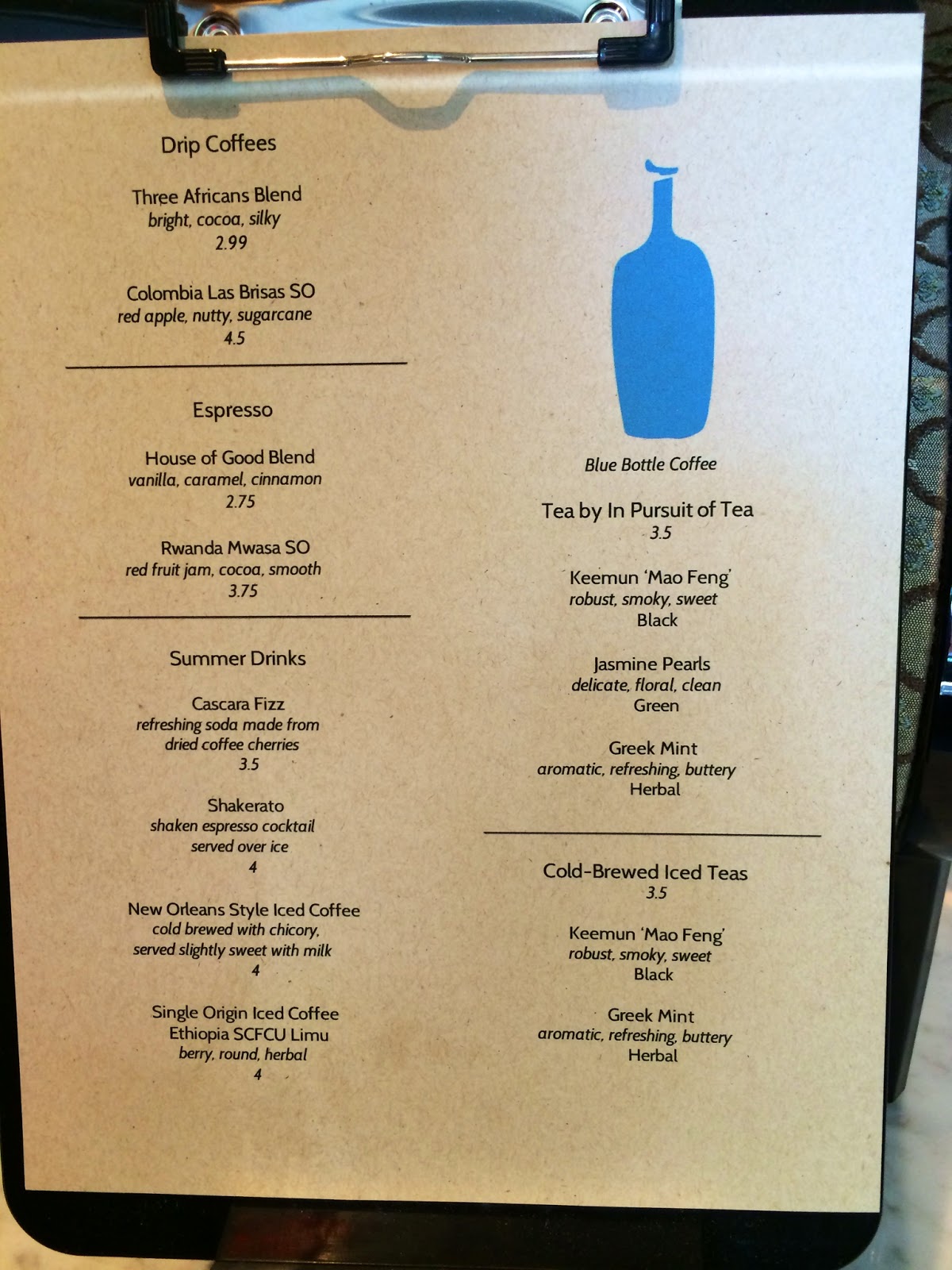
Drank Bar Journal No. 22: Blue Bottle Coffee's Menus


Blue Bottle Coffee took gobs of investor money and is expanding nationally and creating shelf-stable coffee drinks like this chicory milk iced coffee.


They have a few locations in New York City which, thankfully, share none of the twee sluggishness of their Bay Area origins, where it can take you fifteen minutes to get a cappuccino when you're fourth in line.

At each location they do a nice job of making a big menu feel manageable by turning it into two menus.

The first menu lists standards and it's posted big, in permanent metal, on the wall.


The second is the daily or weekly specials and it's posted small, on paper, on a clipboard.


The classics seem permanent. The specials, printed on a laserjet, seem like they're just here for the moment. It keeps things clean and organized, which, if you've ever visited a Blue Bottle shop, seems totally in sync with their semi-OCD look and feel. All in all, I thought it was a good way to differentiate a shop and organize what's offered—and price different coffees differently. Zoom in and you can read the prices for the different drip cups and espressos.

The Dean Street location in my neighborhood also has a sweet upholstery espresso machine cozy.


Sunday, August 17, 2014

Recent Reading


In the seven years of bike share programs in American big cities people have taken 23 million trips and experienced zero fatalities. Turns out that, unlike adding more cars to roads which causes more deadly accidents, adding more bikes causes fewer.


Friday, August 15, 2014

Silicon Valley wants to deliver your food


Restaurants and small food shops have always been flustered by delivery. On the one hand they could help customers—and find more of them—if they took orders online and delivered. On the other hand there's the problem of how to price delivery, the logistics of delivery and the problem of setting up an online order system and making sure its inventory is accurate.

In the last year there's been a wave of new Silicon valley start-ups that try to help with the last part—the online order system. 

The most prominet are Grubhub and Seamless. They take orders for restaurants. The restaurants figure out how to make the food and deliver it. Grubhub and Seamless take a cut that's probably around 20%. Speaking personally, I've used Seamless a lot in Brooklyn and it's very good. The benefit to a restaurant here is that they only have to figure out the logistics part of delivery. They can put all or just part of their menu online—and make it available at times that make sense to them.  Take Prime Meats in my neighborhood, a fancy restaurant that's full almost every night. They are on Seamless but in order to prevent overburdening their kitchen they initially showed up on Seamless only between 5 and 7pm, when they were slow.

In the novelty arena, you can also order pizza on a smartphone, albeit in a ridiculous way. There's a one button app that, when you push it, delivers pizza in 30 minutes. From somewhere. Anywhere.

In a more interesting twist, Square, the payment processing software company, is buying a food delivery company called Caviar. This is the only Silicon Valley firm I know trying to do the delivery part of the delivery business. Presumably the idea here is that a restaurant can buy their POS system from Square and the delivery software—and delivery logistics team—will come along with it.

This is happening with grocery, too. I just spent time at Bi-Rite and talked with the GM Patrick (ex-Zingerman's Deli manager) and learned about Instacart, which Bi-Rite just joined. With Instacart you place your grocery order online and they find someone to go get it from you. It's not an employee of the grocery store, it's not an employee of Instacart, it's just some shmo who signed up to be a grocery store picker. (They call them pickers, just like we do for people who pick items for boxes on our production line). Like with Grubhub and Seamless, Instacart takes a cut.

How these all play out will be interesting. Short-sighted merchants, or ones that do their own order and delivery, may look at the cut these companies take and say they don't need to pay someone else for something they can do on their own. The problem there is they will be shut out of network effects. The more merchants sign on to Seamless the more common it'll be for customers to shop there. If you're a merchant and you're not there, you'll loose out. Merchants will be saving cost to give up sales, which is rarely a good move.

What's the downside for the customer? On the restaurant side there seem to be very few negatives. Seamless doesn't mark up for delivery so why not order online and get the same food you could have driven to pick up brought to you for free? On the grocery side, I can see inventory being a hard nut to crack. Right now Instacart has no database connection between what's for sale online and what's in stock at the merchant. If something is sold out, the merchant has to remember to go to Instacart's website and mark it sold out. Will that happen? Sometimes, but not always. That will mean upset customers. Instacart gives leeway to their pickers to choose subs or call the customer to see what they'd like, but either answer is a flawed fix, one that will frustrate customers and hurt sales.

Thursday, July 24, 2014

Disrupt yourself or be disrupted


You've probably heard of Uber, the car service that works like a cab—except better. You hail an Uber car from an app on your phone. On the app you can see how long the car will take to get to you. When the car arrives Uber texts you (so if you're inside finishing a conversation inside you walk outside and voila!, there's the car—I've used it a lot and it really does work this smoothly). You can select the size of your car (big SUV if you need to haul the family to the airport). You don't need cash and you don't tip. When you reach your destination you walk out the door and Uber automatically charges your card.

Uber is launching in city after city all over the planet and almost everywhere people are having a fit. Well, not most people, just people who drive cabs for a living. Cabbies are angry, ostensibly, that these "untrained," unlicensed Uber drivers are scooping up their business. I get why that sucks if it's true (in Boston, cab medallion prices, which are basically proxies for how valuable being a cabbie is, have gone up, not down, since Uber came to town which suggests it might not be true.) I think their anger is misplaced, though. They shouldn't be angry at Uber. They should be angry at their employers, the cab companies.

After all, there's no reason why cab companies couldn't do this. Uber's technology is not all that complicated. Any cab company could have done this for their customers years ago and can still do it now. I'm sure someone—or lots of someones—who worked at cab companies has thought of it; I'm sure it was brought up in meetings in cities across the world. All these things Uber does are clearly benefits for customers. So why haven't any cab company on the planet made their own app?

Well, it turns out instead of griping, one finally is. Seoul's cab agency is going to make its own Uber-style app. 

The DNA of Uber is, in practice, very simple. Its power lies in the fact that a huge number of people on the planet now carry a computer connected to the internet in their pockets all day long (we happen to call it a phone). When you use something like Uber for the first time it can seem so obvious you wonder, "Why hasn't this existed before?" The elegance and utility of Uber makes the cabbies argument against it seem archaic. Sorry cabbies, you don't stand a chance on this one. And there are dozens of businesses just like you that are next.

Wednesday, July 23, 2014

Recent Reading

What if UPS and FedEx were like Uber and Lyft, where regular people do the deliveries, not employees? She started a company to see if that can work. 

A 40 fruit tree. Hat tip to Spike. 

Ever wonder what a camel broker eats each day? Hat tip to Val.

Saturday, July 19, 2014