Wednesday, September 25, 2013

Maximal information with minimal ink


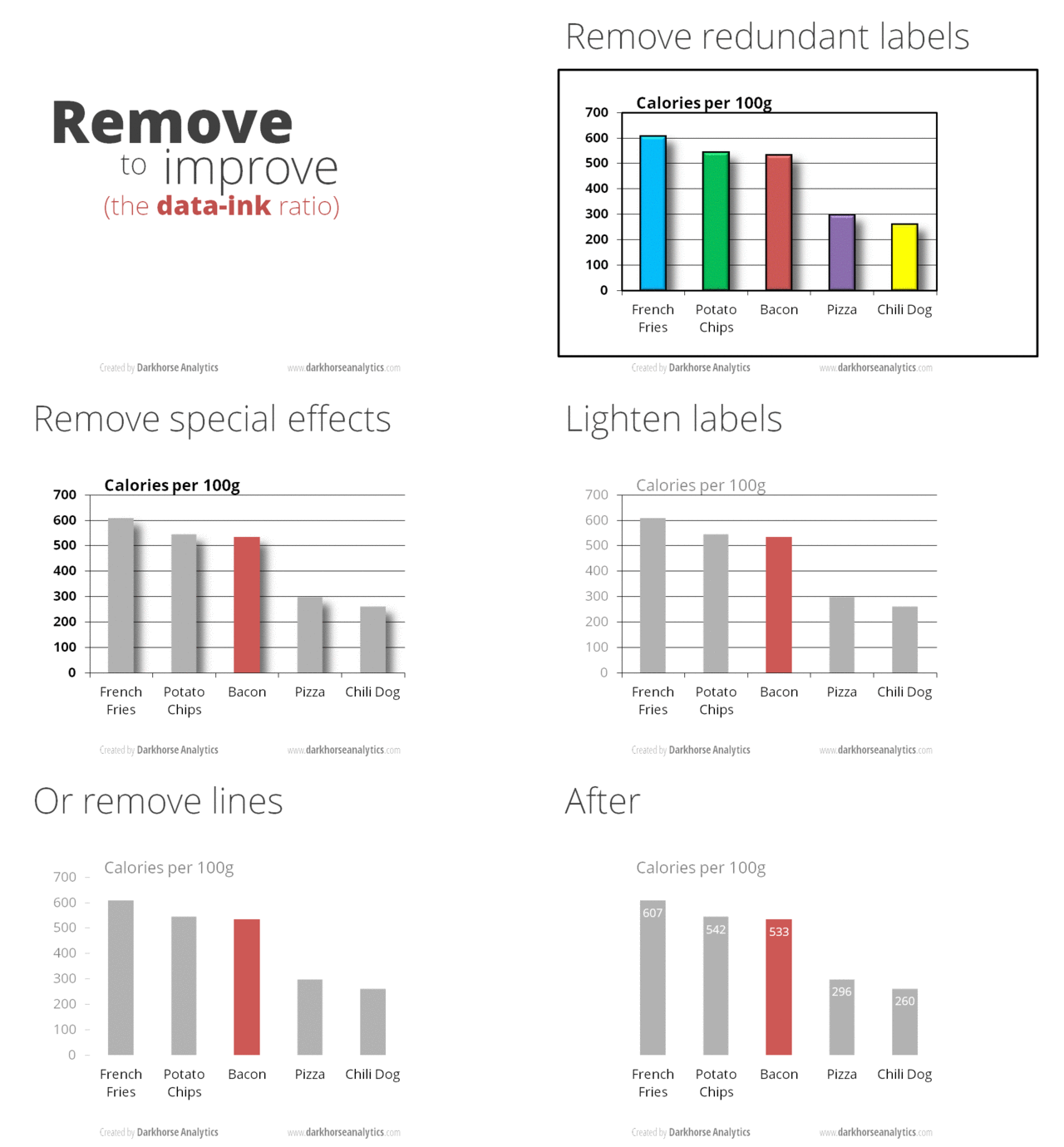
One of Edward Tufte's design maxims is "the greatest number of ideas in the shortest time with the least ink in the smallest space."  Practically speaking, that often means "remove as much garbage as you can" and it's a pretty good rule to design by. Here's a gif that shows how that can play out in an Excel chart.


Tuesday, September 24, 2013

Did they all call forget to each other before they came to work?


I'm sure loads of other people have probably noticed this before me. Microsoft, Google and eBay: their logos are all the same colors. If you didn't know they were different firms you'd almost think they were part of the same company. I guess the old Apple logo had the same thing going on and, for that matter, Apple's new iOS7 colors come garishly close.  


Monday, September 23, 2013

Bacon comes of age in America


We’ve been here before. A food that was quiet, served on the side, didn’t make much of a fuss turns into a superstar. Suddenly it’s everywhere: in magazines, books, blogs, radio, TV. Celebrities cozy up to it. Wannabees cling to it. Everyone rides its coattails up and a lot of money and fame are had. Along the way comes the backlash. The haters talk about how it’s over the top, how it’s jumped the shark, how they knew about it when—and, now that it’s famous, it’s not nearly as good.

Bacon is this decade's food star and its story hews to the storyline. Well, sort of. In truth, I haven’t seen many foods experience quite as meteoric a rise as bacon. At least not foods I’m used to selling (I'm looking at you, coconut water). There are parallels, though. Take olive oil.

Two decades ago good extra virgin olive oil was a mainstay of few shops in America, let alone households.  You could find glittering five liter tins of it at “ethnic” markets—that is, Italian shops in Italian neighborhoods—and that was about it. Twenty years later you’d be hard pressed not to find a pretty decent bottle of olive oil in most food retailers and homes. Even the supermarket stuff can be pretty good. It’s part of many people’s everyday cooking. The health aspects certainly didn’t hurt its rise to ubiquity, but I think most of its growth can be attributed to a simpler storyline: it’s a traditional food that tastes great.

Bacon shares the same trait. It tastes great thanks to its DNA flavor strands of salty, smoky, fatty and sweet. It’s as traditional as you can get in our young country, having been a part of American cooking since colonial times. Where it breaks with olive oil's narrative is in its naughty streak. Bacon likes to be bad. Or at least everyone likes to think it does.

I’m as guilty as the next guy in marketing it that way and I don’t quite know why. I’m not alone. There’s something about it that makes people go a little crazy. It’s like that friend who always gets you drunker than you want to be. Bacon makes people act dirty. They sigh when they eat it. It’s the gateway meat that breaks the will of vegetarians. And of course, no religion (at least none I know of) outlaws olive oil but two of the planet's major faiths forbid bacon. (Speaking of which, you should read some of the gleefully guilt-ridden gift messages practicing Jews to write each other when they send our bacon.)

Bacon is here to stay. In ten years we might not have any more bacon festivals or, God help us, bacon flavored lip balm. But I’m convinced we’ll have better tasting bacon in more homes than ever. 


Wednesday, September 11, 2013

Recent Reading: More on the movement to end restaurant tipping

"By removing tipping from the Linkery, we aligned ourselves with every other business model in America. Servers and management could work together toward one goal: giving all of our guests the best possible experience. When we did it well, we all made more money. Tips don't improve service. Removing tips improves wages and profit. All kinds of things that no one ever tells you and more."


There are articles coming out on this every week. Sometime soon I half expect someone to go health care on the subject and defend the practice on the basis that most of the world already bans tips and we're different—but better—because of our American system of restaurant tipping. I won't hold my breath.

Tuesday, September 10, 2013

Why is one tinned tuna better than another?


Take two tins of tuna, one from Ortiz, one typical of the supermarket. One smells like the sweet sea, peels off in thick blond chunks and tastes like a fancy dinner out. The other smells like harbor at low tide, spoons out in pulpy shreds and tastes like saltwater. They came from the same animal living in the same ocean. What happened? Here are a five buyer's guide tips to understand what makes one tinned tuna different from another.

1. How are the tuna fished?
Bonito tuna, a common species for tinning, are not big fish. Most are two feet long and weigh about ten pounds. They’re warm-blooded. Taken together that means any bruising or bleeding affects a large portion of each fish and muddies its flavor. That’s rare with Ortiz’s tuna since they are entirely line caught, classic fisherman style, one at a time on a rod. It’s more common with netted fish—the most common way to catch tuna, where hundred foot long nets drag the tuna in a thrashing bundle up from the sea.

2. How are they stored at sea?
Tuna are stored in a boat’s hold on ice. A more conscientious captain will freight a lot of ice, enough to surround each fish so they don’t touch one another and cool down quickly. After all, no one knows how long they’ll be at sea or how much they'll catch and the fish starts to deteriorate the moment it’s caught.

3. What happens after they're cooked?
Cooking canned tuna is more or less standardized: the fish is boiled in salted water for a couple hours. But what happens next is not at all the same from factory to factory. At Ortiz the just-cooked fish sits out to cool in the kitchen, then gets time to chill in cold storage. The two steps take hours and hog up space on the floor and in the refrigerators. Not all tuna makers choose to take it.  Like most food makers who worry about price more than flavor, they cut time out of the equation. What the extra time and care does, though, is critical. It stops the fish from fermenting. Fermenting can be ruinous—a carbonation that makes the tins unsalable—or it can be mild. Even mild fermentation has a flavor that, to my taste, is a sour tang that runs throughout most tins of cheap tuna and mars its sea-sweet origins.

4. How are they cleaned?
Another act of grace Ortiz commits after cooking is to clean its tuna by hand. This is as labor-intensive as it sounds (if you’ve ever deboned and skinned cooked fish you know what I mean). It's not at all standard practice in the tuna world. The women—and I can say from my experience visiting that 100% of the cleaners are women—work meticulously with paring knives, scraping and cleaning every bruise, every discoloration, every chance for the flavor to head south, leaving only pristine fish to find their way into the tin.

5. What goes into the tin?
Whole chunks of fish and olive oil. That’s it. No flakes, no water. That’s the way you get great tinned tuna. Shredded smaller pieces deteriorate faster and that will show in the flavor. As for olive oil, well, the American tuna industry has pawned off water-packed tuna as healthier but what they failed to mention was that in losing 20% of the calories we lost 98% of the taste. Water leaches flavor from the fish. Ortiz only packs in olive oil, which amplifies the tuna’s flavor and gives it a silky, rich mouthfeel.
Saturday, August 3, 2013

Ideas worth stealing: Chipotle's giveaway card


Chipotle continues to do great informational marketing, even when they're giving burritos away. Everyone in the company gets these to hand out at will. What doesn't come through in my scan is the heft and quality of the card. It's as thick as a refrigerator magnet and "bean genius" is printed in reflective foil. Why do such a high level print job on a giveaway? Exactly.


Wednesday, July 31, 2013

Recipes with pictures: visualize your mac and cheese


In the upcoming Fall Buyer's Guide I write about how recipes in cookbooks often fail. They could get better if they borrowed this idea from the back of a box of Annie's macaroni and cheese — visual instructions add a lot of clarity.